Pakistan stock market signals are everywhere: in chat groups, on social media and in apps. Some are little more than a ticker and an excited message; others are structured trade plans. This guide explains how to tell the difference, how to read a complete PSX signal, how to think about KSE-100 stocks, and how to manage risk so that one bad trade never damages your account. It uses the signal format MaxTrade uses for the Pakistan Stock Exchange: Buy, Sell or Hold, with Entry, Stop Loss, TP1, TP2 and a risk tag.
What a PSX signal should contain
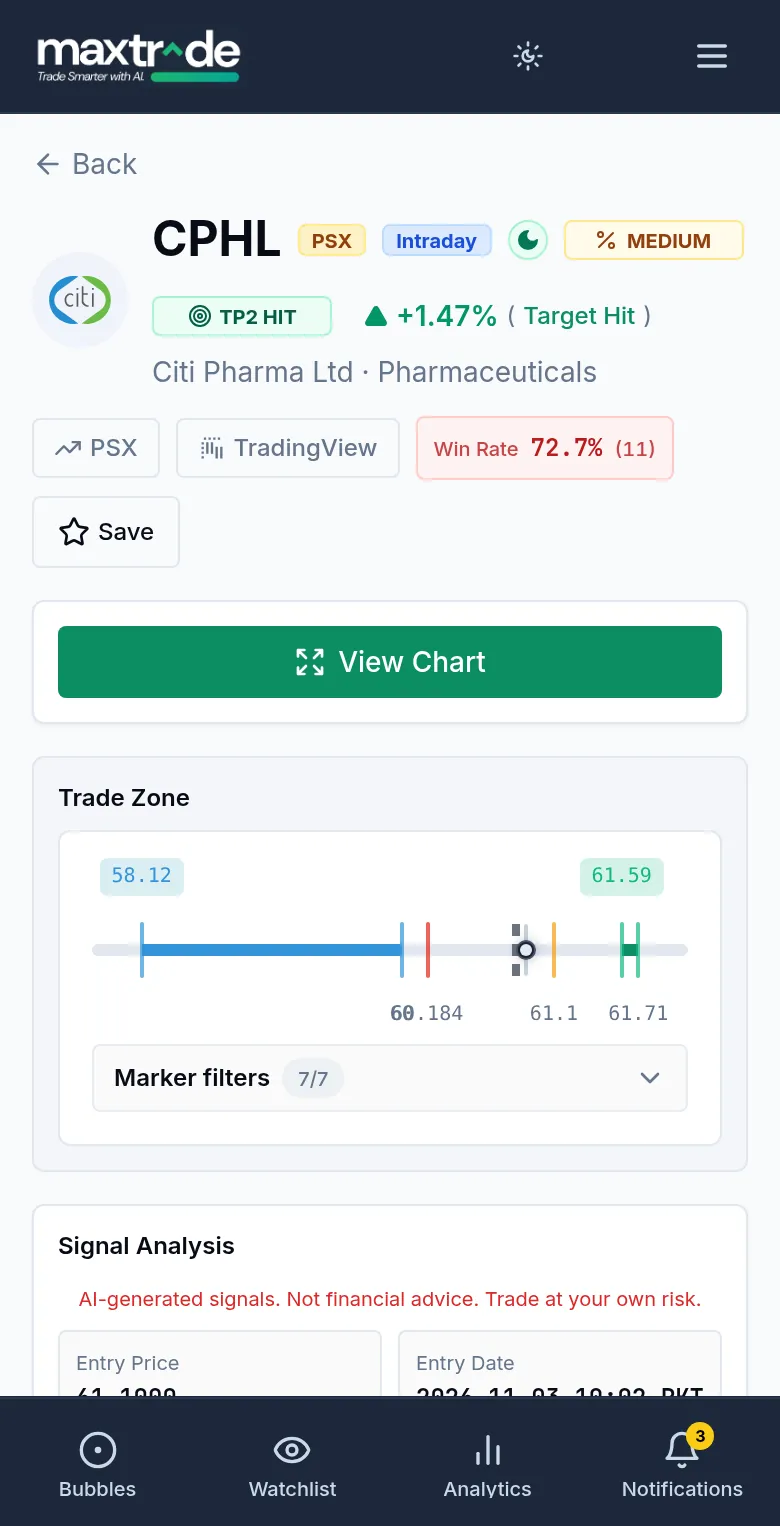
A useful PSX signal answers every question you need before you place an order. Which stock? Which direction? Where does the setup become valid? Where is it wrong? Where do you take profit? MaxTrade signals answer these with a direction label (Buy, Sell or Hold), an Entry price, a Stop Loss, two take-profit levels called TP1 and TP2, and a Risk Level tag of Low, Medium or High. If a signal you receive anywhere is missing a stop loss, treat it as incomplete: without one, you have no defined plan for when the idea fails.
Understanding the KSE-100 context
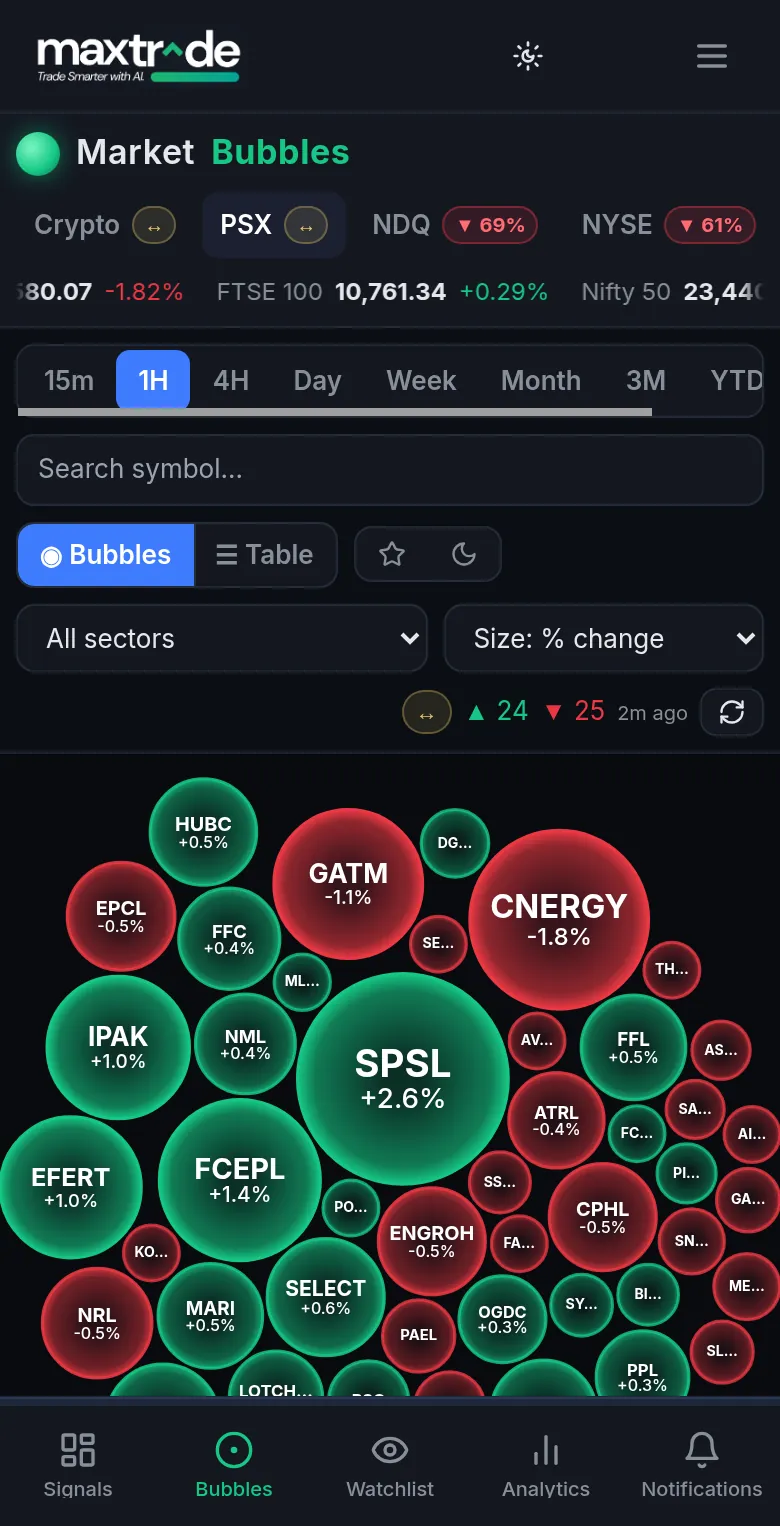
The KSE-100 index tracks major companies listed on the Pakistan Stock Exchange, and many active traders concentrate on its constituents because they tend to be among the more widely followed names. When you read a signal on an individual stock, it helps to glance at what the broader index is doing. A Buy signal on a single stock while the wider market is under heavy pressure carries different context from the same signal in a calm market. The signal gives you levels; your judgment about the overall market helps you decide how much size, if any, to commit.
Reading Buy, Sell and Hold on PSX
A Buy signal means the analysis favors the price moving higher from the entry level. A Sell signal means the analysis favors the price moving lower; for most PSX traders that is a cue to exit a holding or avoid a stock rather than to open a short position. A Hold signal means there is no clear edge right now. Hold is underrated: avoiding weak setups protects capital just as much as finding strong ones.
Entry: do not chase
The Entry price is the level where the setup is considered valid. PSX stocks can gap at the open or move quickly during the session, so by the time you see a signal the price may already be well away from the entry. If you cannot buy reasonably close to the entry, the risk and reward described by the signal no longer apply. Many traders place limit orders near the entry level and simply skip the trade if it is not filled.
Stop Loss: the most important number
The Stop Loss is where the trade idea is wrong. Decide before you enter that you will exit if price reaches it, and where your broker allows, place the order straight away. Moving the stop further away to avoid a loss is one of the most common and costly mistakes. If the distance to the stop feels too large for your account, the right answer is a smaller position, not a wider stop.
TP1 and TP2: taking profit in stages
TP1 is the first take-profit target and TP2 the second. A practical approach is to sell part of the position at TP1 and hold the rest toward TP2. Some traders also raise their stop to around the entry price once TP1 is reached, so the remaining shares carry less risk. Others exit fully at TP1 to keep things simple. Choose your approach before you enter, not while the price is moving.
Position sizing for PSX trades
Position sizing turns a signal into an order you can live with. Decide what portion of your trading capital you are willing to lose on one trade, keeping it small. Divide that amount by the rupee distance between the entry and the stop loss: the result is the number of shares to buy. Round down to the lot size your broker allows. Done this way, a stopped-out trade costs a known, acceptable amount regardless of the share price.
Using the risk tag
Each MaxTrade signal carries a Low, Medium or High risk tag. Use it to adjust your size: smaller positions for High-risk setups, or skip them entirely if you are new to the market. Even a Low-risk signal can hit its stop, so the tag guides size rather than guaranteeing an outcome.
Building a focused watchlist
Following every listed stock is overwhelming. MaxTrade lets you set a Watchlist and filter signals down to the specific markets or tickers you trade. Many PSX traders start with a small group of KSE-100 names in sectors they understand, which keeps the feed manageable and makes it easier to learn how those stocks behave.
Signals support decisions; they do not make them
MaxTrade is a signal-calling app, not an auto-trading or execution app. It does not connect to your brokerage account or place orders. You review each signal, decide whether it fits your plan and place any trade yourself through your own PSX broker. Before relying on any signals, review the history: the MaxTrade dashboard shows Targets Hit, Stopped Out, Exited Early and Unconfirmed counts, with Entry and Exit details for every past signal, wins and losses alike.
A simple PSX checklist
Check the direction and the broader KSE-100 context. Confirm the price is still close to the entry. Calculate position size from the stop loss. Decide your plan for TP1 and TP2. Reduce size for higher-risk tags. Place the stop. Then record the trade in a journal and review it afterwards. Consistency with this process matters more than any single signal.
Frequently asked questions
What are Pakistan stock market signals?
They are trade ideas for stocks listed on the Pakistan Stock Exchange. A complete signal includes a direction plus Entry, Stop Loss and take-profit levels, which MaxTrade provides as Entry, Stop Loss, TP1 and TP2.
Can I focus only on KSE-100 stocks?
Yes. You can set a Watchlist and filter signals down to the specific markets or tickers you trade.
Does MaxTrade place PSX trades for me?
No. MaxTrade is a signal-calling app, not an auto-trading or execution app. You decide whether and when to place each trade through your own broker.
Can PSX signals guarantee profit?
No. No AI signal bot can guarantee profit, and MaxTrade doesn't claim to. Markets remain unpredictable, and trading involves the risk of losing your capital.