
Related: PSX calls — our main page for PSX calls and PSX trading signals.
PSX algo trading means using written rules, and usually software, to decide when to buy or sell shares on the Pakistan Stock Exchange. Some people mean a fully automated system that sends orders to a broker. Others simply mean a rules-based method they follow by hand. The phrase covers both, which is why it causes so much confusion.
This guide explains what algorithmic trading on the PSX actually involves, who it suits, and why a trade-setups feed is a different thing from a live execution API. Not financial advice. Every trading approach, automated or manual, carries the risk of loss.
MaxTrade is a trade-setups app, not a broker or an order-placing robot. It covers the Pakistan Stock Exchange alongside NASDAQ, NYSE, LSE, NSE India, Tadawul, ADX, DFM, QSE, and crypto via Binance.
What PSX algo trading means
At its core, an algorithm is a set of rules precise enough that a computer could follow them. "Buy when the stock closes above its 50-day average on volume twice its normal level, with a stop below the last swing low" is an algorithm. "Buy when it feels strong" is not.
PSX algorithmic trading applies those rules to Pakistan stocks. The rules might come from price action, moving averages, momentum, index context or a mix. What makes it algorithmic is not the computer; it is the fact that every decision follows a defined rule, so the same inputs always give the same output.
That consistency is the main appeal. Rules do not get nervous after three losses or greedy after three gains. They also have a weakness: they keep doing exactly what they were told, even when conditions change and the rule no longer fits the market.
The building blocks of an algorithmic strategy
Whether you code it or follow it by hand, a complete rules-based approach needs the same parts:
- Universe: which stocks the rules apply to, for example liquid KSE-100 names only.
- Entry rule: the exact condition that opens a position.
- Stop rule: the price or condition that says the idea is wrong.
- Exit rule: where targets sit, or how a trailing stop works.
- Sizing rule: how much to risk per idea, usually a fixed share of the account measured from entry to stop.
- Filters: conditions that switch the strategy off, such as a falling index or results season for that company.
If any part is missing, it is not really a system. Many "bots" shared in groups have an entry rule and nothing else, which leaves the hardest decisions to chance.
Three levels of automated PSX trading
It helps to separate automated PSX trading into three levels, because each one carries different work and different risk.
Level 1: rules, applied by you. You scan charts against a written checklist and place orders yourself. Nothing is automated, but the decisions are systematic. This is where most traders should start.
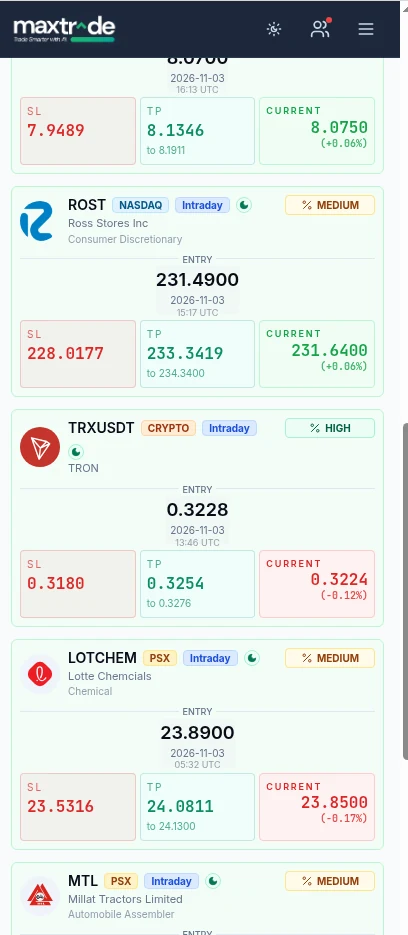
Level 2: automated analysis, manual orders. Software scans the market and produces trade setups: direction, entry, stop and targets. You review each one and decide whether to place it through your broker. You keep full control of your account.
Level 3: automated execution. Software both decides and sends orders to the exchange through a broker connection. This is what most people picture when they hear "algo trading". It needs broker support, technical skill, constant monitoring and careful testing, because a bug can place real orders in seconds.
Who PSX algorithmic trading is for
Full execution algorithms suit a fairly narrow group: people who can code, who understand testing and its traps, who have a broker that offers suitable order access, and who can watch the system during market hours. Institutions and a few experienced individuals fall into this group.
Most retail traders in Pakistan get more value from the first two levels. A written rule set removes impulse decisions, and automated analysis saves hours of chart scanning, without the operational risk of letting software touch your account.
Be wary of anyone selling a ready-made PSX robot with promised returns. No system can guarantee results, past test results often look better than live trading, and a product that needs your broker login deserves careful questions about custody and security.
Execution is the hard part
A rule that looks clean on a historical chart can behave very differently live. On the PSX, a few local factors make execution harder than the rules suggest:
- Liquidity: many listed names trade thinly, so an order can move the price or sit unfilled.
- Price limits: a stock can lock at its daily limit, which may make a stop impossible to fill that session.
- Session hours: official PSX timings differ on Fridays, and the opening and closing periods can be volatile.
- Costs: commissions, taxes and the bid-offer spread add up quickly for strategies that trade often.
- Data quality: gaps or errors in historical prices can make a test look far better than reality.
Any honest test should include these costs and limits. If a strategy only works when you ignore them, it does not work.
A trade-setups feed is not an execution API
This is the distinction that matters most. An execution API is a technical connection that lets software send buy and sell orders into your brokerage account. A trade-setups feed is a list of planned ideas, each with entry, stop loss and targets, that a person reads and judges.
The difference changes who is in control. With an execution API, the software acts and you supervise. With a setups feed, the software suggests and you act. The feed never holds your funds, never needs your broker password, and cannot place an order by mistake.
For many traders, a setups feed captures most of what they wanted from algo trading: consistent, rules-based ideas across many stocks, without writing code or handing over account access. For a deeper comparison, read setups bot vs auto-trading bot.
Is a KSE 100 trading bot right for you?
Ask yourself a few plain questions before you look for a KSE 100 trading bot or any other automated tool:
- Can you explain every rule the tool follows, including when it exits?
- Do you know how it behaves in a falling or range-bound market, not only a rising one?
- Does it need access to your broker account, and if so, what happens if it fails mid-session?
- Can you size each position from the stop, so one loss stays small?
- Will you still review ideas yourself, or will you trust it blindly?
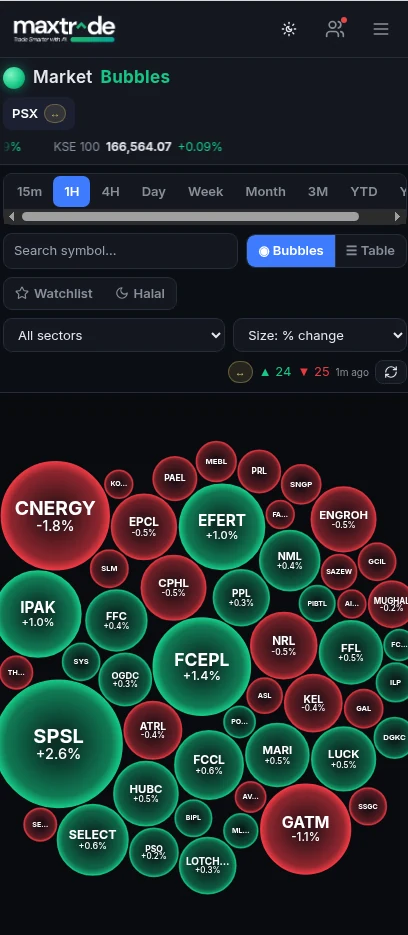
If several answers are unclear, start with a rules-based checklist and a setups tool, then build up from there. Our guides on PSX technical analysis and the PSX trading bot cover the chart reading and the bot question in more detail.
Where MaxTrade fits
MaxTrade sits at Level 2. Its models scan Pakistan stocks and publish trade setups with direction, entry, stop loss, TP1 and TP2, plus a risk tag. A dashboard records how earlier setups resolved, including those stopped out. It does not connect to your broker, hold funds or place orders; you decide, and you act through your own broker.
The same card format runs across all ten markets: NASDAQ, NYSE, LSE, NSE India, PSX, Tadawul, ADX, DFM, QSE, and crypto via Binance. See the Pakistan stock trade-setups page for PSX cards and how MaxTrade works for the full flow.
Whatever level you choose, the basics stay the same: written rules, a stop on every idea, and size from the stop. Not financial advice.
Frequently asked questions
What is PSX algo trading?
It is trading Pakistan Stock Exchange shares with written rules, often run by software. It can mean rules you follow by hand, automated analysis that produces trade setups, or fully automated order execution through a broker.
Is algorithmic trading allowed on the PSX?
Rules-based trading is a normal approach. Fully automated order execution depends on what your broker supports and on current exchange and regulator rules, so check with your broker before connecting any software to your account.
Is a PSX trading bot the same as algo trading?
Not always. Some tools called bots only publish trade setups for you to review, while others place orders automatically. Ask whether the tool needs access to your brokerage account; if it does, treat it as an execution system.
Do I need to code to use automated PSX trading tools?
Not for a setups app. You only need to read the plan on each card and size it sensibly. Building your own execution algorithm does require coding, testing and ongoing monitoring.
Does MaxTrade place trades for me?
No. MaxTrade is a trade-setups app. It shows entry, stop loss, TP1 and TP2 for you to review, and you place any order yourself through your own broker. Not financial advice.

