
Almost every crypto app now calls itself AI. Some use machine learning to scan hundreds of pairs, some use a few indicators with a new label, and some never explain what happens behind the screen. If you are looking for an AI crypto trading app, the label alone tells you very little.
This guide shows what a good AI based crypto trading app should put in front of you, how to check its past ideas without trusting a sales page, and which claims are a reason to close the app. Not financial advice. Crypto is volatile, and every approach can lose money.
MaxTrade is an AI trade-setups app. It does not place orders or hold exchange keys, and it covers NASDAQ, NYSE, LSE, NSE India, PSX, Tadawul, ADX, DFM, QSE, and crypto via Binance.
What an AI crypto trading app really does
Under the hood, most AI crypto tools do one of three jobs. They scan many pairs at once and flag the ones that match a pattern. They score a possible trade by weighing trend, momentum, volume, and volatility. Or they execute, turning a model's output into orders on your exchange account.
The first two jobs save time. Bitcoin, Ethereum, and hundreds of altcoins trade every hour of every day, and no person can watch all of them. A model that narrows the list to a handful of clear setups is useful, as long as you can see why it picked them.
The third job is a different product. Once software can place orders, the question is no longer whether an idea looks sensible but whether you trust a system to act without you. That is why it helps to know which kind of AI crypto trading app you are installing before you look at any feature list.
What the AI should show you on every setup
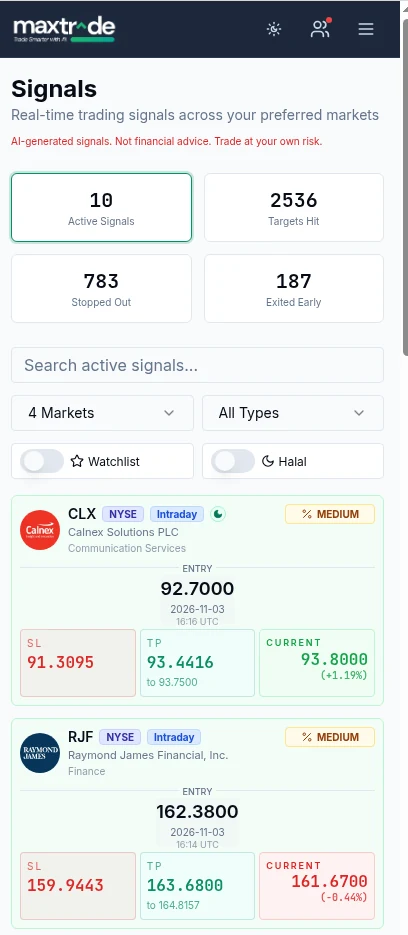
An AI is only as useful as what it lets you check. A strong setup card answers the questions you would ask a human analyst:
- Pair and direction. For example BTC/USDT, long or short.
- Entry area. A price or a narrow range, not "buy now".
- Stop loss. The level where the idea is wrong. A setup without a stop is a guess.
- Targets. At least two, often TP1 and TP2, so you can plan partial exits.
- Timestamp and status. When it was published, and whether it is open, hit a target, or was stopped out.
- A short reason. Trend, a level, a volume change. Enough to see the logic, even if the model itself stays private.
If any of these are missing, you cannot size a position or review the idea later. Our guide on how to read a trade setup walks through each field with an example.
How to check the history yourself
The fastest way to judge any AI crypto trading app is to ignore its headline numbers and look at its record. You are not trying to prove it works. You are checking whether it is honest about when it does not.
- Find closed setups, not just open ones. An app that only shows live ideas gives you nothing to judge.
- Look for losing trades. Every approach has them. A record with no stop-outs has been edited.
- Check timestamps against the chart. Pick five old setups and open the pair on Binance or a charting site. Was the entry reachable after the time it was posted?
- Watch for a few weeks before you act. Note new setups in a simple log and see how they play out. It costs nothing but patience.
- Compare across market conditions. A model that looks sharp in a strong uptrend may struggle in a sideways month. Look at both.
If the app makes this hard, that tells you something too. Good tools want you to look.
Marketing claims to ignore
Some phrases appear on many AI crypto pages and carry no information you can use:
- A single success percentage with no list of trades behind it.
- "Guaranteed" or fixed returns. No model can promise this, and claims like it are a common sign of a scam.
- Screenshots of one great week. Anyone can crop a chart.
- "Secret" or "institutional" AI with no explanation of what it looks at.
- Pressure to deposit with the app itself, or to send coins to a wallet it controls.
Treat these as noise. What matters is the complete plan on each card and a record you can check.
AI crypto trading bot app vs AI trade-setups app
An AI crypto trading bot app connects to your exchange with API keys and places orders based on its model. It can act faster than you and never sleeps, but you hand over control, and a bug, an outage, or a leaked key can hurt you through trades alone.
An AI trade-setups app uses the model to find and describe trades, then stops. You read the plan, decide whether it fits your rules, and place any order yourself. It is slower, but nothing touches your account without you.
Neither is right for everyone. If you are weighing a bot that trades on Binance, our post on crypto trading bots for Binance covers key permissions and safety steps. If you prefer to keep the decision, the rest of this guide applies directly.
A seven-point test for the best AI crypto trading app
There is no single best AI crypto trading app for every trader, but the good ones pass the same test:
- Complete setups. Entry, stop, and targets on every idea.
- Public, dated record. Closed trades with outcomes, including losses.
- Clear about execution. It says plainly whether it places orders.
- No key collection unless it is a bot, and then never withdrawal rights.
- Plain-language reasons for each setup.
- No return promises anywhere in the app or its ads.
- A real company with terms, a privacy policy, and support you can reach.
For a wider look at choosing between apps, see our guide to choosing a crypto trade-setups app.
Where MaxTrade fits
MaxTrade is an AI trade-setups app. Its AI scans markets and publishes setups with entry, stop loss, TP1, and TP2, each with a status you can come back to. It does not connect to Binance, does not hold API keys, and does not place orders, so every decision stays with you.
The same card format covers crypto via Binance pairs and stocks on NASDAQ, NYSE, LSE, NSE India, PSX, Tadawul, ADX, DFM, and QSE. See how MaxTrade works, or browse the crypto trade setups page for the pairs it follows.
Whichever app you choose, size each position from the stop so a loss is affordable, and keep your own log of what you did and why. Not financial advice.
Frequently asked questions
What is an AI crypto trading app?
It is an app that uses AI or machine learning to scan crypto pairs and suggest or place trades. Some only publish trade setups for you to review; others connect to your exchange and place orders.
What is the best AI crypto trading app?
There is no single best one for everyone. Look for complete setups with entry, stop and targets, a dated public record that includes losses, clear rules on whether it places orders, and no promises of returns.
Is an AI based crypto trading app safe?
No app removes market risk. A trade-setups app that never asks for exchange keys has less account risk than a bot. If you use a bot, never enable withdrawal permissions and fund only what you can afford to lose.
Can AI predict crypto prices?
AI can spot patterns and rank possible trades, but it cannot know the future. Every model has losing periods, so judge it by its full record and always use a stop.
Does MaxTrade trade crypto for me?
No. MaxTrade is an AI trade-setups app. It shows entry, stop loss, TP1 and TP2 for crypto via Binance and nine stock markets, and you place any order yourself. Not financial advice.
