
Most people start trading with crypto the same way: they buy a coin that is trending, watch it swing, and make decisions on emotion. A few weeks later they have a mix of small wins and one or two painful losses. The fix is not a secret indicator. It is a simple plan with clear rules for how much to risk, where to set a stop loss and take profit, and when to stay out. This beginner guide gives you exactly that, in steps you can follow from your first trade.
Before you start: the beginner basics
Use a reputable exchange, enable two-factor authentication, and start with spot trading rather than futures or leverage. Only use money you can afford to lose completely; crypto can fall sharply in a single day. Learn three order types: market orders (fill immediately at the current price), limit orders (fill only at your chosen price or better) and stop orders (trigger when price reaches a level). Those three are enough to run a full risk-managed crypto trading strategy.
Rule 1: Decide your risk per trade
Pick a fixed percentage of your trading account to risk on any single trade, typically 0.5% to 1% when you are learning. This number is not how much you invest; it is how much you lose if the stop loss is hit. With a $1,000 account and 1% risk, every losing trade costs about $10. A run of five losses costs about $50, which is uncomfortable but survivable. Risking 20% per trade, by contrast, can wipe out most of the account in a bad week.
Rule 2: Always use a stop loss and take profit
A stop loss take profit plan in crypto means every trade has an exit for being wrong and an exit for being right before you enter. Place the stop at a level where the trade idea is clearly invalid, not at an arbitrary percentage. Place the take profit at a realistic target, such as a prior high or a level given in a signal. Aim for trades where the potential reward is at least as large as the risk, ideally larger. Then set both orders on the exchange immediately, so the plan works even while you sleep.
Rule 3: Size every position from the stop
Position size = amount you are willing to lose ÷ distance from entry to stop. Worked example with illustrative numbers: account $1,000, risk 1% = $10. You plan to buy a coin at $2.00 with a stop at $1.90, so the risk per coin is $0.10. $10 ÷ $0.10 = 100 coins, a $200 position. If your target is $2.20, the reward is $20, twice the risk. This calculation keeps the loss fixed no matter how volatile or cheap the coin looks.
Worked example: one trade from start to finish
Here is how the rules fit together, using illustrative numbers only. You open the MaxTrade app in the evening and see a Mini Swing crypto signal with a High probability rating: entry $10.00, SL $9.50, TP $11.00. Price is currently $10.05, close enough to the entry. Your account is $1,000 and your risk is 1%, so you can lose $10. The stop distance is $0.50, so $10 ÷ $0.50 = 20 coins, a $200 position. The reward to TP is $1.00 per coin, $20 in total, twice the risk. You place a limit buy at $10.00, and once filled you set an OCO order with the stop at $9.50 and the target at $11.00. Two days later the trade either hits TP for about $20, hits SL for about $10, or you exit early if something changes. In every case you knew the outcome range before you clicked buy, which is the whole point of a risk-managed plan.
Rule 4: Trade only clear setups
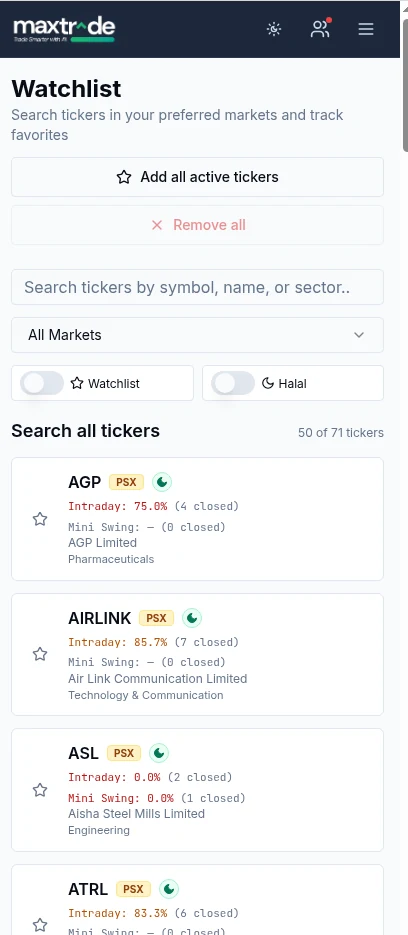
Beginners often overtrade. Set a short list of conditions you need before entering, for example: a signal or setup with a defined entry, SL and TP; price still near the entry; a reward at least equal to the risk; and no major news event in the next few hours. If any condition is missing, skip. Using structured crypto signals, such as those in the MaxTrade app, helps here because each signal already gives the entry, SL and TP along with a Medium or High probability rating and an Intraday or Mini Swing type.
Rule 5: Limit daily and weekly losses
Add a circuit breaker. For example: stop trading for the day after two losing trades, and pause for the week if your account is down 3%. These limits protect you from revenge trading, the urge to win back a loss immediately with a bigger or rushed trade. Professional traders treat a pause as part of the plan, not as a failure.
A simple weekly routine
Sunday: review last week's trades in a journal, noting entry, exit, result and whether you followed the rules. Each trading day: check the market mood, for instance with the MaxTrade Market Bubbles heatmap, then look through signals that match your style and your watchlist. Take only setups that pass your checklist, size them from the stop and set the orders. End of day: record any trades and close the app. The routine matters more than any single trade.
Choosing a crypto trading strategy that fits you
If you can watch the market during the day, Intraday setups give quick feedback but demand attention. If you have a job or studies, Mini Swing setups that develop over a few days are usually easier to manage, because your orders do the work between check-ins. If you follow Islamic finance principles, use a Halal filter to focus on assets that pass Shariah screening; MaxTrade includes one in the signals feed. Pick one style, follow it for at least a few dozen trades and review before changing anything.
What realistic results look like
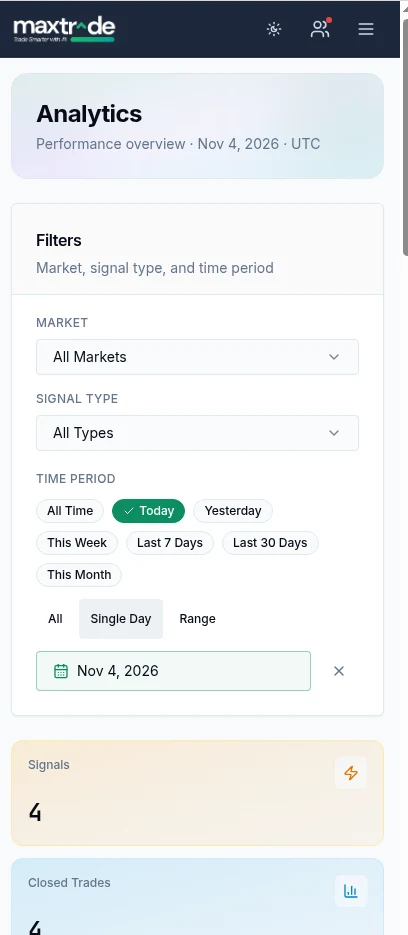
Even good strategies lose regularly. At the time of writing, the MaxTrade app shows 2,536 targets hit, 783 stopped out and 187 exited early across its signal history. These are past results and do not guarantee future performance, but they illustrate an important point: stop-outs are a normal part of trading. A beginner plan succeeds when losses stay small enough that the wins can matter.
Beginner mistakes to avoid
Buying after a coin has already surged on social media hype. Moving a stop loss lower because you "believe" in the coin. Using leverage before you can size spot trades properly. Putting most of your account into one trade. Following many signal channels with conflicting views. Not keeping a journal, which makes it impossible to learn what actually works for you.
Frequently asked questions
How much money do I need to start crypto trading?
You can start with a small amount on most exchanges. What matters more is risking only a small percentage of that amount per trade and using money you can afford to lose.
What is a good stop loss for crypto?
A good stop loss sits where the trade idea is clearly invalid, such as below a recent support level for a long trade. Your position size should then be adjusted so that hitting the stop costs only your chosen risk amount.
Should beginners use leverage?
It is safer to learn on spot trading first. Leverage magnifies both gains and losses and can lead to liquidation quickly in volatile markets.
Can signals help beginners trade crypto?
Structured signals with entry, stop loss and take profit can help beginners follow a clear plan, but they do not guarantee profit. You still decide on position size and whether to take each trade.
Is crypto trading halal?
Views differ among scholars. Many Muslim traders avoid leverage and interest-based products and use Shariah-screened assets. MaxTrade offers a Halal filter, but you should consult a qualified scholar for your own situation.

