
Two traders can use the same stock, the same chart and even the same signal source and still have completely different experiences, simply because one trades intraday and the other swings positions over several days. Choosing the right style is one of the most important decisions you make, because it decides how much time you need, how you manage risk and which signals are useful to you. This guide compares intraday trading and swing trading stocks on the NYSE and NASDAQ and gives you a simple way to choose.
What is intraday trading?
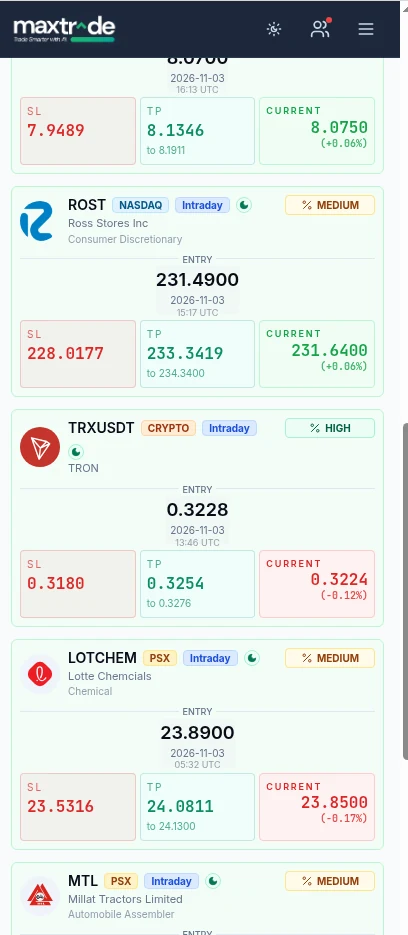
Intraday trading, often called day trading, means opening and closing positions within the same trading session. You never hold overnight, so you avoid overnight gaps, but you need to be available while the market is open. Intraday traders focus on short-term moves, tighter stops and quick decisions. Day trading signals, such as MaxTrade's Intraday signals, are designed to play out within the session and include an entry, a stop loss and a take-profit level suited to that shorter timeframe.
What is swing trading?
Swing trading means holding positions for a few days, sometimes a couple of weeks, to capture a larger move. Swing traders accept overnight risk in exchange for needing far less screen time. Stops are usually wider and targets larger than in day trading. MaxTrade's Mini Swing signals sit in this category: setups expected to develop over a few days, each with an entry, SL and TP, so you can set orders and check in once or twice a day.
Side-by-side comparison
Time needed: intraday requires watching during market hours; swing needs a short daily check. Holding period: intraday is minutes to hours; swing is days. Overnight risk: none for intraday; present for swing, especially around earnings. Stop distance: tighter for intraday, wider for swing, which means smaller share counts per trade for swing at the same risk. Number of trades: intraday tends to produce more trades and therefore more commissions and spread costs. Stress: intraday is fast and intense; swing is slower but requires patience while a trade is open.
A day in the life of each style
An intraday trader in Karachi might sit down around 7:00 p.m. local time, check the market mood and the Intraday signals feed, take one or two setups after the US open, manage them actively and be flat before the closing bell, long after midnight. A swing trader with a day job might spend twenty minutes after dinner reviewing Mini Swing signals and their watchlist, place one bracket order and go to bed. The next evening they check whether the stop or target was hit, adjust nothing unless their rules say so, and review any new setups.
US rules that matter for day traders
In the United States, the Pattern Day Trader rule generally applies to margin accounts with US brokers: making four or more day trades within five business days can require a minimum account equity of $25,000. Cash accounts are not subject to the same rule but must wait for trades to settle before reusing the cash. International brokers may have different rules. Check your broker's policy before choosing an intraday style, because it can limit how often you can trade with a smaller account.
Time zones: a big factor for traders in Asia
US regular hours run from 9:30 a.m. to 4:00 p.m. Eastern Time, which is evening into late night in Pakistan and much of Asia. Intraday trading on that schedule means staying alert late, every trading day. Swing trading often fits better: you can review Mini Swing signals in the evening, place bracket orders with your stop and target, and let them work while you sleep. Be honest about your energy and routine; a style you cannot sustain will not work.
Risk management in each style
The core rules are the same: risk a fixed small percentage per trade, size from the stop distance and always set a stop loss and take profit. What changes is the numbers. Illustrative example with a $5,000 account and 1% risk ($50): an intraday trade with a $0.50 stop allows 100 shares, while a swing trade on the same stock with a $2.50 stop allows 20 shares. Both risk $50. Swing traders should also reduce size or step aside before earnings, since a gap can blow through any stop.
Costs and taxes to consider
Trading costs add up faster than most people expect. Even with zero-commission brokers, you pay the bid-ask spread on every entry and exit, and international traders often pay currency conversion fees when funding a US dollar account. An intraday trader who makes several trades a day pays these costs many times over, so each trade needs a larger edge to stay worthwhile. Swing traders make fewer trades and pay less in total, though some brokers charge fees on holding leveraged positions overnight. Taxes also differ by country: in some jurisdictions short-term gains are taxed differently from longer holdings, and non-US residents may face withholding on dividends. Check the rules where you live and include costs in your journal so your results reflect what you actually keep.
How to choose: a quick self-test
Can you watch the market for at least an hour or two during US hours on most days? If not, choose swing. Is your account below the day-trading equity requirement for your broker? If yes, swing or a cash account is usually more practical. Do you prefer quick feedback and can stay calm making fast decisions? Intraday may suit you. Do you get anxious holding positions overnight? Start with smaller swing positions or intraday. Many traders find a mix works: mostly Mini Swing trades with an occasional Intraday setup when they are available.
Using MaxTrade signals for either style
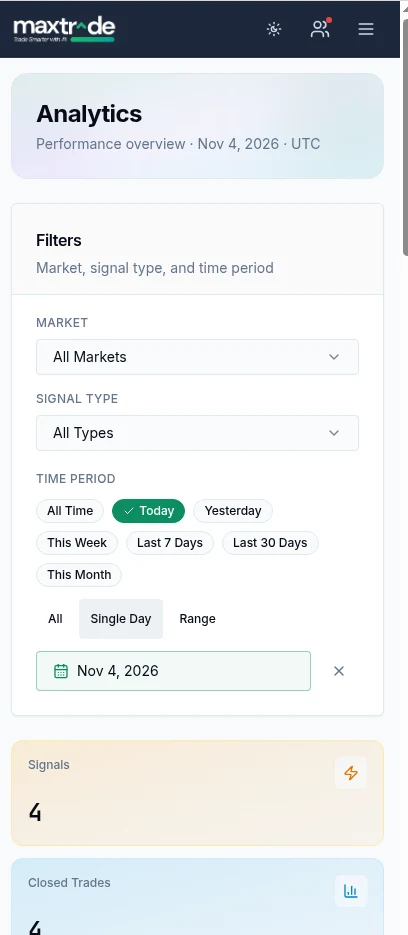
In the MaxTrade app you can filter US stock signals by type, Intraday or Mini Swing, and by market, then add tickers to your watchlist. Each signal shows entry, SL, TP, current price and a Medium or High probability rating. The Analytics screen lets you filter performance by signal type and time period, so you can compare how Intraday and Mini Swing signals have performed. At the time of writing, the app shows 2,536 targets hit, 783 stopped out and 187 exited early overall; past results do not guarantee future performance.
Try one style for a set period
Pick one style and follow it for a fixed number of trades, for example 30, with the same risk per trade and a written journal. Then review: what was your average win and loss, how often did you follow your rules, and how did the style fit your life? Switching styles after every losing trade makes it impossible to learn which one actually suits you.
Frequently asked questions
Is intraday or swing trading better for beginners?
Many beginners find swing trading easier because it needs less screen time and fewer fast decisions. Intraday can work, but it demands focus during market hours and produces more trading costs.
What are day trading signals?
Day trading signals are trade ideas meant to open and close within the same session, with an entry, stop loss and take-profit level. MaxTrade labels these as Intraday signals.
What is a Mini Swing signal?
A Mini Swing signal in MaxTrade is a setup expected to develop over a few days, with its own entry, stop loss and take-profit level.
Do I need $25,000 to day trade US stocks?
The Pattern Day Trader rule generally requires $25,000 in a US margin account for frequent day trading. Cash accounts and some international brokers work differently, so check your broker's rules.
Can swing traders lose more than their stop?
Yes. If a stock gaps past the stop overnight, the order may fill at a worse price. Avoiding earnings and keeping positions modest helps reduce this risk.

