
The US stock market is the deepest and most liquid in the world, with thousands of listed companies on the NYSE and NASDAQ. That choice is also the challenge: finding a good setup among so many tickers takes time most people do not have. US stock signals narrow the field to specific trade ideas with clear levels. This guide explains how stock trading signals work, what is different about US stocks compared with crypto, and a practical checklist for acting on signals for US stocks with defined risk.
What are US stock signals?
A US stock signal is a trade idea on a listed company, such as a NYSE or NASDAQ ticker, that includes an entry price, a stop loss (SL) and a take-profit target (TP). In the MaxTrade app, each US stock signal card also shows the current price, a probability rating of Medium or High and a type of Intraday or Mini Swing, so you can tell at a glance whether the setup matches how you trade. The signal is information; you place any order yourself through your own broker.
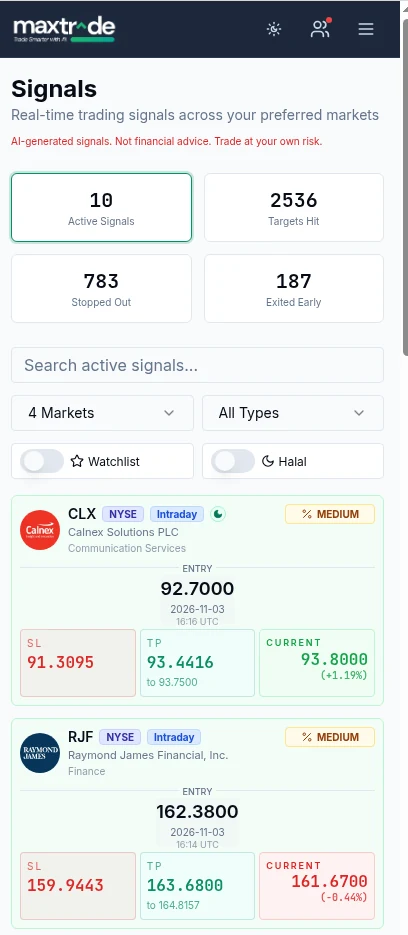
How US stocks differ from crypto
Crypto trades 24/7, but US stocks have set sessions. Regular trading runs 9:30 a.m. to 4:00 p.m. Eastern Time, with thinner pre-market and after-hours sessions around it. That creates overnight gaps: a stock can close at one price and open well above or below it after news or earnings. A stop loss order does not protect you from a gap; if the stock opens below your stop, you are filled at the next available price. Stocks also have scheduled catalysts such as earnings reports, economic data releases and Federal Reserve meetings that can move whole sectors.
NYSE vs NASDAQ setups
The NYSE lists many established companies across industrials, financials, healthcare and consumer goods, which often move more steadily. NASDAQ is home to many technology and growth companies that can be more volatile, with larger daily ranges. Neither is better; they simply behave differently. A practical habit is to reduce position size on more volatile tickers so that the stop distance in dollars stays within your risk limit, and to notice which exchange a signal is on before you act.
Step 1: Filter signals to your schedule
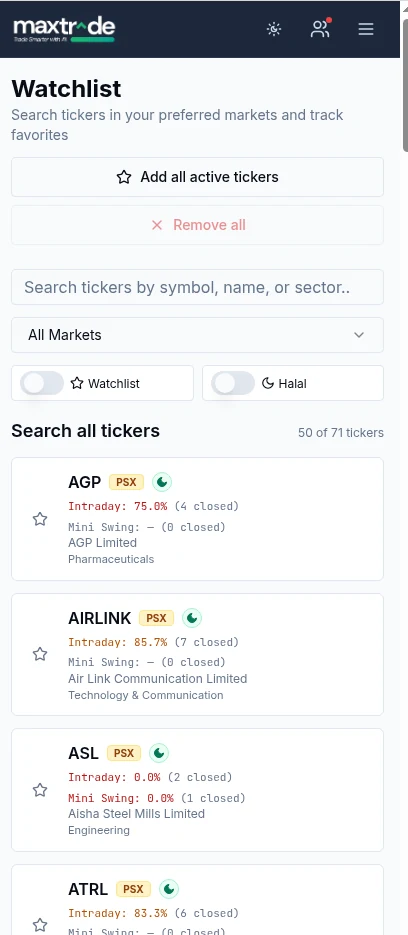
If you work during US market hours, which for traders in Asia often means evenings and nights, Intraday signals may be hard to manage. Mini Swing signals that develop over a few days can suit you better because your stop and target orders work between check-ins. In the MaxTrade app, filter the feed to US stocks and your preferred type, and add tickers you follow to the watchlist. The Halal filter can hide companies that do not pass Shariah screening if you need it.
Step 2: Check the calendar
Before taking any stock signal, check whether the company reports earnings before your planned exit. Earnings can cause moves far larger than the stop distance, in either direction. Many swing traders simply avoid holding through earnings unless that is their deliberate strategy. Also check for major scheduled events such as CPI inflation data or a Fed decision, which can move the whole market at once.
Step 3: Confirm the entry and size the position
Compare the current price with the signal entry. If the stock has already run far toward the target, skip it or wait for a limit fill near the entry. Then size: risk amount ÷ (entry − stop). Illustrative example only: account $5,000, risk 1% = $50. A long signal on a stock with entry $80.00 and SL $77.50 has $2.50 of risk per share, so you buy 20 shares ($1,600 of exposure). If the target is $85.00, the reward is $100, twice the risk. Many brokers now support fractional shares, which helps size positions precisely.
Step 4: Use bracket orders
Most US brokers offer bracket orders: an entry order with an attached stop loss and take-profit order. When the entry fills, the stop and target become active automatically, and when one of them fills the other is cancelled. This is the simplest way to turn a stock trading signal into a complete plan. Check whether your stop orders are set to work only during regular hours or also in extended hours, as brokers handle this differently.
Worked example: a NASDAQ Mini Swing signal
Illustrative numbers only. On a Monday evening you see a Mini Swing signal on a NASDAQ technology stock with a Medium probability rating: entry $120.00, SL $116.00, TP $128.00. You check the calendar: the company reports earnings in three weeks, well after your likely exit, and there is no Fed meeting this week. The stock closed at $120.40, close to the entry. Your account is $4,000 and you risk 1%, or $40. The stop distance is $4.00, so you buy 10 shares ($1,200 of exposure) using a limit bracket order: buy at $120.00, stop at $116.00, target at $128.00. Potential reward is $80, twice the risk. Because it is a Medium probability setup on a volatile NASDAQ name, you could also choose to halve the size. Either way, the decision is made before the market opens, not in the middle of a fast move.
Step 5: Manage and review
Once the bracket is live, avoid widening the stop. If the stock moves strongly in your favor, you may choose to move the stop to entry; decide this rule in advance. After the trade, log it. The MaxTrade Analytics screen lets you filter performance by market, signal type and time period, so you can see how US stock signals have behaved compared with other markets. At the time of writing, the app shows 2,536 targets hit, 783 stopped out and 187 exited early across all its signals; past results do not guarantee future performance.
A US stock signal checklist
Is the signal on a ticker and type that fits my schedule? Is the price still close to the entry? Is there an earnings report or major event before my likely exit? Have I calculated shares from the stop distance and my risk amount? Is my reward at least equal to my risk? Have I placed a bracket order with both SL and TP? If every answer is yes, the trade is a plan, not a guess.
Frequently asked questions
What are stock trading signals?
Stock trading signals are trade ideas on specific stocks that include an entry price, a stop loss and a take-profit target, so you can act with a defined risk.
Can I trade US stock signals from outside the US?
Many international brokers offer access to NYSE and NASDAQ stocks. Check that your broker is regulated in your country and supports the order types you need, such as bracket orders.
What time should I check US stock signals?
US regular trading hours are 9:30 a.m. to 4:00 p.m. Eastern Time. Traders in Pakistan typically see this as evening into night, so Mini Swing signals are often easier to manage than Intraday ones.
Does a stop loss protect me from overnight gaps?
Not fully. If a stock opens beyond your stop, the order fills at the next available price, which can be worse than the stop level. Smaller positions and avoiding earnings reduce this risk.
Does MaxTrade place stock trades for me?
No. MaxTrade is a signals app. You read the entry, SL and TP and decide whether to place the trade with your own broker.


