
People looking for structured trade ideas on NASDAQ-listed names, and often on the wider US market as well, want more than a ticker and a hunch. The useful version is a trade setup with an entry, a stop and targets, read in the context of the US session.
This article is tighter on that context — regular hours, pre-market and after-hours, the NASDAQ-100, and earnings — and it does not repeat the step-by-step walkthrough already on our US stock setups guide. Not financial advice. US stocks can gap, and every approach carries the risk of loss.
MaxTrade is a trade-setups app, not a broker or a robo-advisor. It covers NASDAQ, NYSE, LSE, NSE India, PSX, Tadawul, ADX, DFM, QSE, and crypto via Binance.
What NASDAQ trading signals actually refer to
People typing this query may mean trade setups on individual NASDAQ stocks, ideas tied to the NASDAQ-100, or US-listed names in general. The listing venue is a useful filter, but it is not a strategy by itself. A complete trade setup still needs an entry area, a stop, TP1 and TP2, and a holding style that matches the session you can actually watch.
If you wanted a walkthrough of how to read those fields and size a position, that lives on the US stock setups guide. Here the focus is the market clock and the index context that sit around the card.
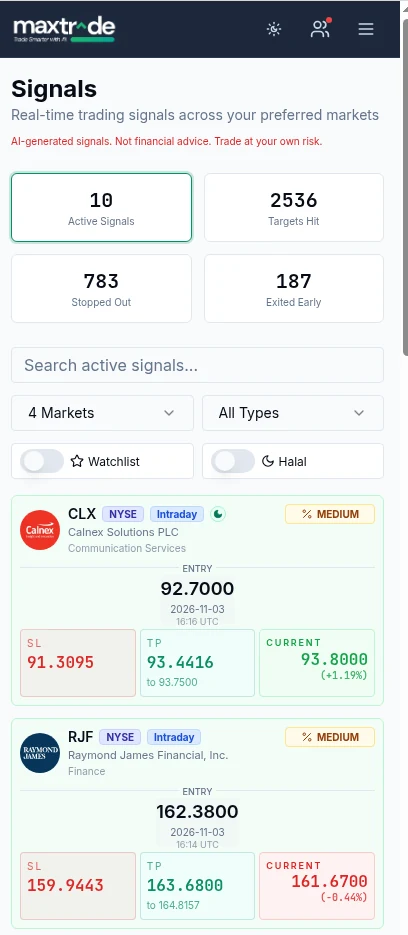
US stock trading signals versus a complete trade setup
The longer phrase and the shorter one are often used interchangeably. In practice, the useful version is a plan: direction, entry, invalidation and targets, published with a time you can check. A name and a “buy” is not enough, especially when the US market can gap at the open.
The setup does not tell you that you must trade it. It gives you a defined idea you can accept, skip, or wait on if the open has already left the entry area.
NYSE and NASDAQ: why the listing venue matters
NYSE and NASDAQ share the same regular session, 9:30 a.m. to 4:00 p.m. Eastern Time, and both run opening and closing auctions. The difference you feel is usually the kind of company and the liquidity of the specific name, not the clock.
NASDAQ is where many large US technology and growth names are listed, which is why NASDAQ and the NASDAQ-100 come up so often in the same search. NYSE still lists a deep set of industrial, financial and consumer names. Spreads, gap risk and news sensitivity vary name by name. A trade setup should be read against that name’s own liquidity, not against a stereotype of the exchange.
NASDAQ 100 trading signals and index context
This can mean ideas on the index itself, or — more often for a single-stock app — using the NASDAQ-100 (NDX) as context for a name that sits inside it or trades with it. If the index is having a wide, one-way session, a single-stock setup can be helped or crowded out by that move.
Index context is not a reason to ignore the stop on the individual card. It is a reason to check whether the idea still makes sense if the basket is already extended, or if leadership has flipped during the day. MaxTrade does not tell you to trade the index itself. It publishes trade setups on names, and the index is one more piece of context, the way a sector move can be.
US session hours, pre-market and the close
Regular trading hours for NYSE and NASDAQ are 9:30 a.m. to 4:00 p.m. Eastern Time. Pre-market activity often starts as early as 4:00 a.m. Eastern, and after-hours can run until 8:00 p.m. Eastern. Liquidity is usually thinner outside the regular session, and prices can move on far less size.
If you are in Asia/Karachi (UTC+5), the regular US session falls in the evening and late night. During US Eastern Standard Time it runs about 7:30 p.m. to 2:00 a.m. Pakistan time. During Eastern Daylight Time it runs about 6:30 p.m. to 1:00 a.m. Pakistan time. That schedule is why many traders outside the United States prefer setups meant to develop over several days, and why an idea published for the open may already be stale if you only check the app the next morning.
The open and the close deserve extra care. The first minutes after 9:30 a.m. Eastern can be noisy as the auction and overnight news are absorbed. The closing auction can also move a name. If a setup’s entry was written for the regular session and you are acting in pre-market, you are not following the same plan.
Earnings, gaps and overnight risk
A US-listed stock can open far from the previous close after earnings, guidance, or macro news. A stop you place during the session may not be filled at that price if the next open gaps through it. That is not a reason to skip stops; it is a reason to know that a stop is not a ceiling on the loss when the market is closed.
Before you act on a trade setup, check the earnings calendar and any known event for that name. If results are due before the next open, the published plan may not survive the print. Skipping the idea is a valid use of the app. For a comparison of holding through the close versus flattening the same day, see intraday versus swing trading on US stocks.
How to read AI stock signals on US names
People also use this phrase for model- or rules-based trade setups on stocks. As with crypto, the label is less important than the card. You should still see entry, stop, TP1 and TP2, a timestamp, and a history that includes stopped-out cases.
An AI stock tool is also not a broker and not a robo-advisor. If it asks for a brokerage API key, you are in execution territory. MaxTrade does not place US stock orders. You review the setup and, if you choose to act, you place the order through your own broker. How it works explains that split.
Where MaxTrade fits
The US stock trade setups page is the pillar for NYSE and NASDAQ. How it works explains the product. The step-by-step US guide and the intraday versus swing comparison cover process and holding style. MaxTrade also publishes trade setups on LSE, NSE India, PSX, Tadawul, ADX, DFM, QSE, and crypto via Binance, alongside NASDAQ and NYSE.
You stay in control of every decision. Not financial advice.
Frequently asked questions
What are NASDAQ trading signals?
They are structured trade ideas on NASDAQ-listed names — and sometimes on the wider US market — that should include an entry, a stop and targets. They are plans to review, not orders placed on your behalf.
What is the difference between NYSE and NASDAQ trade setups?
The regular session is the same. The listing venue often clusters different kinds of companies, and liquidity is specific to each name. Read the setup against that name and the session, not against a stereotype of the exchange.
When is the US stock session if I am outside the United States?
Regular hours are 9:30 a.m. to 4:00 p.m. Eastern Time. In Pakistan that is about 7:30 p.m. to 2:00 a.m. during Eastern Standard Time, and about 6:30 p.m. to 1:00 a.m. during Eastern Daylight Time. Pre-market and after-hours extend earlier and later, with thinner liquidity.
Do NASDAQ 100 trading signals mean I should trade the index itself?
Not necessarily. Many people use the NASDAQ-100 as context for single-stock trade setups. Whether you trade an index product is a separate decision, and it is not something this article recommends.
Does MaxTrade place US stock orders for me?
No. MaxTrade is a trade-setups app. It shows entry, stop loss, TP1 and TP2 for you to review, and you place any order yourself through your own broker. Not financial advice.

