
Traders look for Bitcoin trade ideas because BTC moves fast and never closes. A clear idea with an entry, a stop and a target looks like a shortcut through the noise. It can be useful, but only if you know how to read it and how to act on it without risking more than you planned.
This guide explains what a Bitcoin trade setup should contain, why BTC and ETH need different handling from stocks, and how to turn an idea into a plan on Binance. Not financial advice. Crypto is volatile, and any trade can lose money.
MaxTrade is an AI trade-setups app. It does not place orders or hold exchange keys, and it covers NASDAQ, NYSE, LSE, NSE India, PSX, Tadawul, ADX, DFM, QSE, and crypto via Binance.
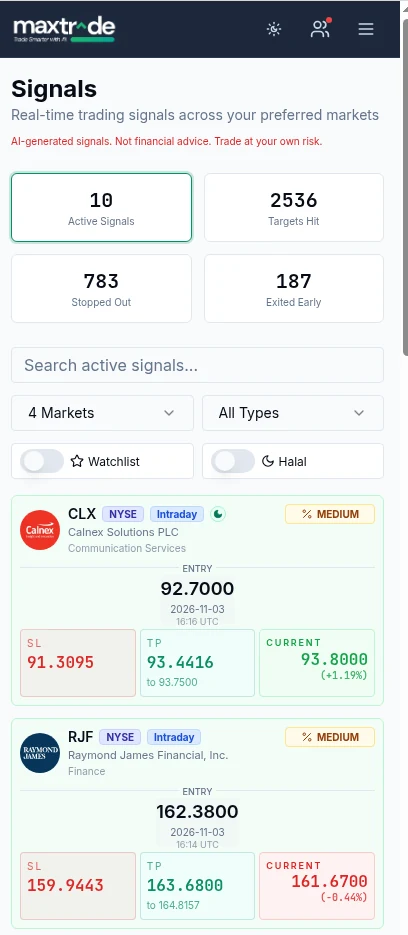
What a Bitcoin trade setup contains
A trade setup is a written plan for one possible trade. For Bitcoin it should answer five questions before you touch the order screen:
- Pair and direction. Usually BTC/USDT, long or short. Spot traders can only go long.
- Entry area. A price or a narrow range. "Buy BTC now" is not a plan.
- Stop loss. The price where the idea is wrong. It is set before entry, not after the trade turns against you.
- Targets. Often TP1 and TP2, so you can take part of the position off early and let the rest run.
- Time and status. When the setup was published and whether it is open, hit a target or was stopped out.
If one of these is missing, you cannot size the trade or review it later. Our guide on how to read a trade setup walks through each field with a worked example.
Why BTC behaves differently from stocks
A stock on NASDAQ or NYSE trades for set hours and pauses overnight. Bitcoin trades every minute of every day, on many exchanges at once. That changes how you read any setup:
- No opening gap protection. There is no market close, so a move can happen while you sleep. A resting stop order matters more than ever.
- Weekend liquidity is thinner. Fewer large participants trade on Saturday and Sunday, so price can jump through levels more easily.
- Session overlaps still matter. Volume often rises when Asian, European and US hours overlap. Breakouts during quiet hours fail more often.
- Volatility is higher. A daily range of several percent is normal for BTC. A stop that suits a large-cap stock may be far too tight here.
- News is global and constant. ETF flows, rate decisions, exchange news and large liquidations can move price at any hour.
None of this makes Bitcoin trade setups better or worse than stock ideas. It means the stop, the size and the time you hold the trade all need more care.
Reading a BTC/USDT setup step by step
Take a simple example. The figures below are made up to show the method, not a live idea.
- Read the direction and entry. Long BTC/USDT, entry zone 64,000 to 64,400.
- Find the stop. Stop at 62,900. If you enter at 64,200, your risk is 1,300 per BTC, about 2 percent.
- Check the targets. TP1 at 66,000 and TP2 at 68,000. TP1 is 1,800 above entry, so the reward is larger than the risk.
- Size from the stop. If you accept a loss of 50 USDT on this trade, divide 50 by 1,300. That gives roughly 0.038 BTC, whatever your account size.
- Decide what happens at TP1. Many traders close half and move the stop to entry. Decide this now, not in the moment.
- Check the time. If the setup is several hours old and price has already left the entry zone, skip it. Chasing changes the risk.
This process works the same for any coin and any market. The only thing that changes is how wide the stop needs to be.
Bitcoin day trading setups vs swing setups
When people search for Bitcoin day trading ideas, they usually mean setups meant to open and close within one day. Swing setups are held for several days or weeks.
Day trading setups use short charts, such as 15-minute or 1-hour candles, with tighter stops and closer targets. They need you to watch the screen, react quickly and accept more small losses. Fees and spreads take a larger share of each trade.
Swing setups use 4-hour or daily charts. Stops are wider, so the position is smaller, but you do not need to watch every candle. They suit people with a job or other commitments.
Neither style is safer by default. Pick the one that matches the time you can give, and do not switch styles in the middle of a trade because it moved against you.
Ethereum trading signals: what changes with ETH
Ethereum setups use the same five fields, but ETH tends to move more than BTC in both directions. In a strong Bitcoin rally, ETH can rise faster. In a sell-off, it often falls harder.
- Use wider stops in percentage terms. A stop distance that works for BTC may be hit by normal ETH noise.
- Watch the ETH/BTC ratio. If ETH is weak against BTC, a long ETH/USDT setup is working against the tide.
- Do not double the same bet. A long BTC and a long ETH trade at the same time are closely linked. Count them as one larger position when you size risk.
Binance trading signals and execution
Most retail crypto trading happens on Binance, so many setups are written with Binance pairs in mind. A few points help you turn an idea into an order there:
- Spot vs futures. Spot buying owns the coin and cannot be liquidated. Futures add leverage, and a liquidation price can sit closer than your stop if leverage is high.
- Funding rates. On perpetual futures, longs and shorts pay each other every few hours. Holding a swing trade for days can add a real cost.
- Order types. A limit order inside the entry zone avoids paying a wide spread. Place the stop as a stop-limit or stop-market order straight after entry.
- Price differences. Prices on Binance can differ slightly from a chart built on another exchange. Leave a small buffer around levels.
If you are thinking about connecting a bot to Binance to place orders for you, read our guide to crypto trading bots for Binance first. It covers API key permissions and why withdrawal rights should never be enabled.
Risk rules that matter more than any setup
A good setup can still lose. What decides your long-run result is how much you risk each time and whether you follow your own rules.
- Risk a small, fixed share per trade. Many traders keep it to 1 percent of their account or less.
- Always place the stop. A mental stop is easy to move. A resting order is not.
- Keep leverage low or skip it. High leverage turns normal BTC noise into liquidations.
- Keep a log. Note each setup you took, why, and how it ended. Patterns in your own behaviour show up fast.
- Judge any source by its full record. Look for closed trades, including losses. Our guide to judging an AI crypto trading app explains how to check history yourself.
Where MaxTrade fits
MaxTrade is an AI trade-setups app. For crypto it follows Binance pairs, including BTC/USDT and ETH/USDT, and publishes setups with entry, stop loss, TP1 and TP2, each with a status you can check later. It does not connect to your exchange, does not hold API keys and does not place orders, so every decision stays with you.
The same card format covers stocks on NASDAQ, NYSE, LSE, NSE India, PSX, Tadawul, ADX, DFM and QSE. See how MaxTrade works, browse the crypto trade setups page, or compare apps with our guide to choosing a crypto trade-setups app.
Whatever you trade, size each position from the stop so a loss is affordable, and treat every idea as one input to your own decision. Not financial advice.
Frequently asked questions
What are Bitcoin trading signals?
They are trade ideas for BTC, usually with a direction, an entry area, a stop loss and one or more targets. MaxTrade calls them trade setups. They are a plan to review, not an instruction to buy or sell.
Are Bitcoin day trading setups different from swing setups?
Yes. Day trading setups use short charts, tighter stops and are closed within a day. Swing setups use 4-hour or daily charts, wider stops and smaller positions, and are held for days or weeks.
Do the same rules work for Ethereum trading?
The structure is the same, but ETH usually moves more than BTC. Use wider stops in percentage terms, watch the ETH/BTC ratio and count a BTC and an ETH long as one linked position when sizing risk.
Can I use Binance trade setups on futures?
You can, but leverage and funding add risk. Check that your liquidation price sits well beyond the stop, and remember that funding payments add up on trades held for days.
Does MaxTrade place Bitcoin trades for me?
No. MaxTrade is an AI trade-setups app. It shows entry, stop loss, TP1 and TP2 for crypto via Binance and nine stock markets, and you place any order yourself. Not financial advice.
